LamA - Charging at the workplace

As part of LamA, an extensive charging infrastructure is being set up at Fraunhofer Institutes throughout Germany. The Fraunhofer ISE is considered a lighthouse location in the project, as in addition to a high number of over 40 new charging points, various research topics such as the implementation of local charging management or feedback are being considered.
Implementation of local charging management
For the network integration of installed charging points, we implement a local charging management system. This system manages the charging processes while considering the existing building load to avoid exceeding connection capacities. Additionally, control signals from the local distribution network operator, as well as user inputs regarding desired departure time and battery level, are integrated. For the distribution network operator bnNetze, this provides a control option to react to bottlenecks in the distribution network and regulate the high grid consumption from charging electric vehicles.
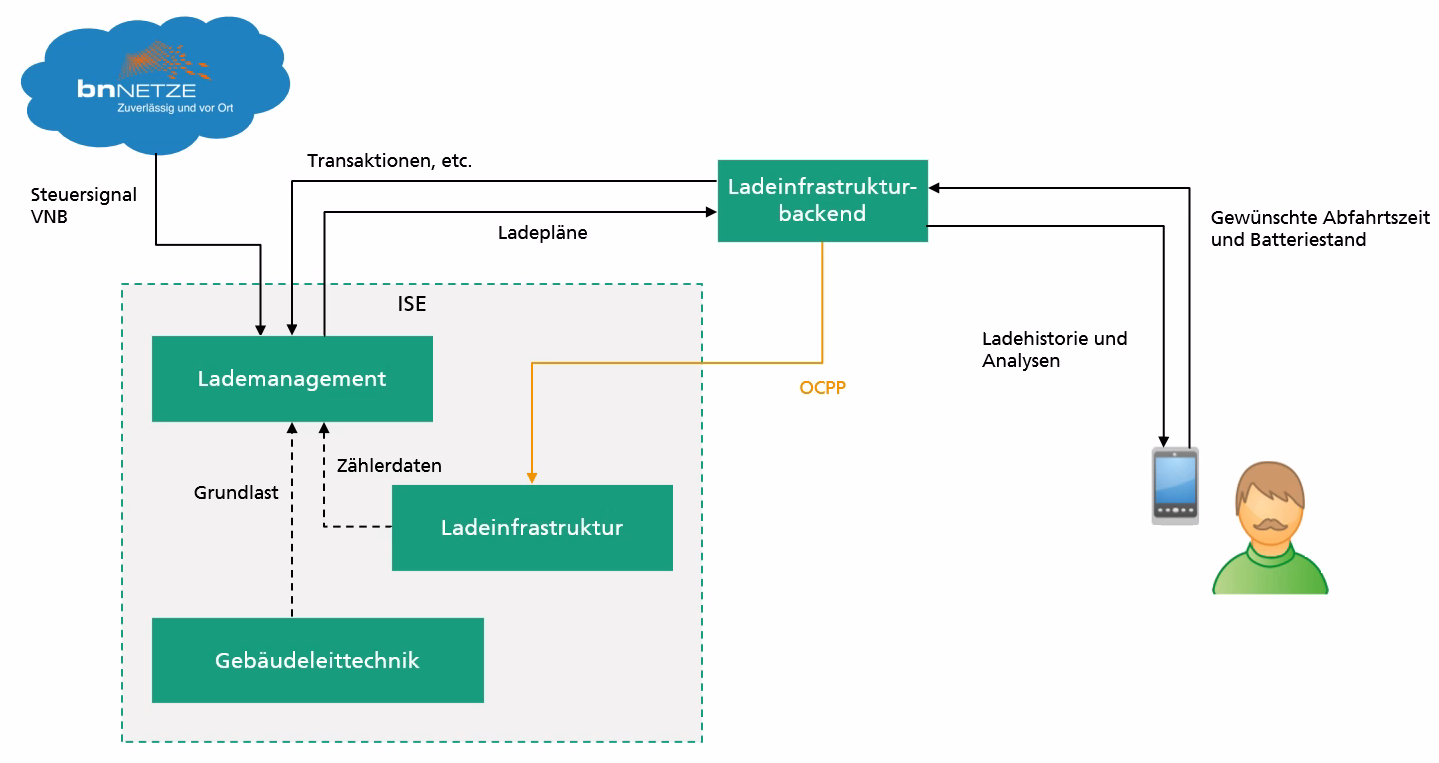
The resulting charging schedules are sent to a superior charging infrastructure backend, which forwards the schedules to the charging points via the Open Charge Point Protocol (OCPP). By using a central cloud-based backend, a uniform interface is created that allows the charging points of every participating Fraunhofer Institute to be operated uniformly.
Construction of a Bidirectional Charging Infrastructure
In our lab, we are developing a charging infrastructure for conducting bidirectional charging processes. For this purpose, we rely on standardized protocols such as ISO 15118-20, which already defines use cases for power backfeeding. A self-implemented EEBus stack is used to connect to a local charging management system to read out necessary parameters for our charging algorithm and set charging schedules. For the setup with market-available hardware, we use an AC wallbox with an integrated charging controller from in-tech. We can enhance this with our software components for EEBus and ISO 15118-20 communication. We implement a backfeed-capable vehicle with a hardware-in-the-loop simulator, which can also be controlled via ISO 15118-20.

To generate bidirectional charging schedules, our self-developed charging algorithm for backfeeding has been expanded. It integrates various parameters such as departure time, battery capacity, and minimum/maximum (dis)charging power into its optimization. The power specifications from the schedules are then passed on to the wallbox via EEBus and realistically implemented by the installed hardware.

Further information on LamA.
LamA Press Release on the Practical Test at Fraunhofer ISE